

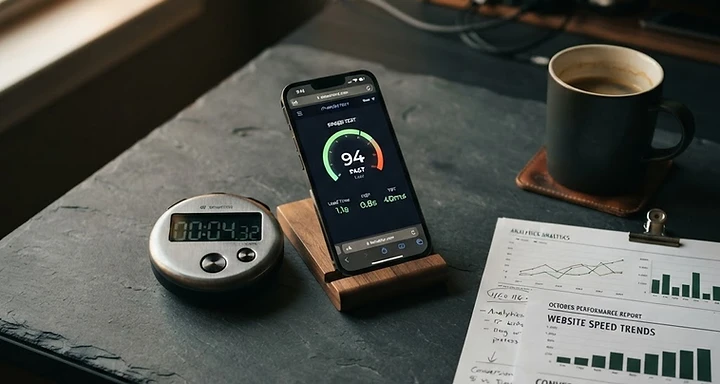
Does website speed really affect sales?
Yes — measurably. Studies consistently show conversion rates drop roughly 4% for every extra second of load time, and Google uses Core Web Vitals as a ranking signal. A slow site loses you customers twice: in search results, then again on arrival.
What "fast" actually means
- LCP (Largest Contentful Paint) under 2.5s — your main content appears quickly
- INP (Interaction to Next Paint) under 200ms — taps and clicks feel instant
- CLS (Cumulative Layout Shift) under 0.1 — nothing jumps around while loading
These three numbers are Google's definition of a good experience, and they're measurable for free in PageSpeed Insights.
Where the time usually goes
In our audits, the same culprits appear again and again:
- Uncompressed images — often 70% of page weight. Modern formats (AVIF/WebP) with proper sizing fix this.
- Render-blocking scripts — chat widgets, trackers and sliders loading before your content.
- No code splitting — shipping the entire site's code to every page.
- Cheap hosting — a slow server caps everything else.
The compounding return
Performance work is unusual marketing spend: you pay once and it keeps converting. Faster sites rank higher, which brings more visitors, who convert at a higher rate. That's three multipliers from one investment — typically a one-to-two-week project.
Speed is a conversion feature, not a technical vanity metric
Every extra second of load time costs you a measurable share of visitors. The pattern is consistent across industries: the fastest experience wins clicks, calls and forms. What makes speed such a good investment is that it compounds. It improves paid ad performance, organic rankings, bounce rates and conversion rates all at once, and once it is fixed it stays fixed.
Where the money is actually lost
Paid traffic. If you spend £600 a month on Google Ads and your landing page takes five seconds on 4G, a meaningful chunk of every click is wasted before the page renders. Halving load time is effectively a discount on every click you buy.
Organic traffic. Core Web Vitals are a ranking signal. Slow pages get outranked by faster competitors with comparable content, which means less free traffic forever.
Trust. Users read slowness as unprofessional. A sluggish site makes people assume the business is disorganised, whether or not that is fair.
The three numbers to watch
- Largest Contentful Paint (LCP): under 2.5 seconds. How quickly the main content appears.
- Interaction to Next Paint (INP): under 200 milliseconds. How responsive it feels when tapped.
- Cumulative Layout Shift (CLS): under 0.1. Whether content jumps around while loading.
Test on a real phone on mobile data, not a desktop on office broadband. PageSpeed Insights and Search Console's Core Web Vitals report both give you field data from real users, which is the number that counts.
What actually makes small business sites slow
- Uncompressed hero images and photo galleries served at full camera resolution
- Sliders and carousels that load every slide before anything is visible
- Ten to thirty plugins, each adding its own CSS and JavaScript
- Page-builder markup producing enormous, deeply nested HTML
- Fonts loaded from multiple sources, blocking text rendering
- Third-party embeds: chat widgets, pixels, review carousels, map iframes
- Cheap shared hosting with slow server response times
The fix list, in order of return
- Convert images to WebP, resize to display dimensions, lazy-load anything below the fold.
- Remove plugins you do not genuinely need — most sites can lose half of them.
- Self-host fonts, limit to two families, use font-display: swap.
- Defer non-critical JavaScript, delay chat and tracking widgets until interaction.
- Move to edge hosting with proper caching and a CDN.
- Replace sliders with a single static hero image and a clear call to action.
- Reserve space for images and embeds to eliminate layout shift.
- If the site is a page-builder build, seriously price a hand-coded rebuild.
A realistic worked example
A local service business getting 1,500 visits a month at a 2% enquiry rate produces 30 enquiries. Cut load time from 4.5 seconds to 1.4 and a lift to 2.8% is a normal outcome — that is 42 enquiries from the same traffic. If your average job is worth £900 and you close one in four, that is roughly £2,700 of extra work a month from a one-off technical fix. Very little marketing spend behaves like that.
Speed is cheaper than more traffic
Buying more traffic costs money every single month. Fixing speed costs money once. Most owners reach for ads first because it feels like action, when the cheaper move is making the traffic they already pay for actually convert.
How to check where you stand today
Run your homepage and your two most important service pages through PageSpeed Insights on mobile. Note LCP and CLS. Then open Search Console and check how many URLs are flagged as needing improvement. If most of your pages fail, performance is the highest-return project on your list this quarter, ahead of new design, new copy or new ad campaigns.