
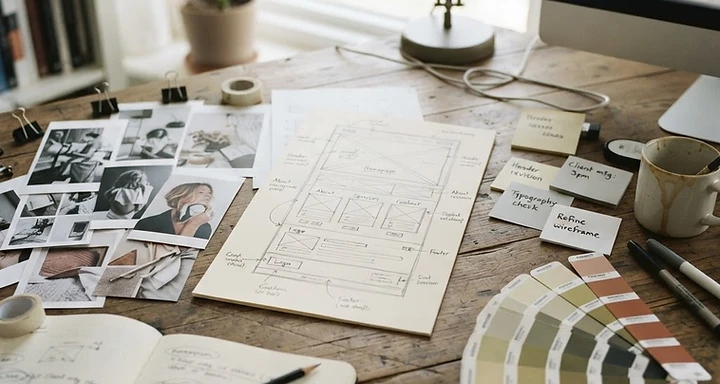
Ten minutes of preparation before your first call with a web designer can take two or three weeks off the project. Not because designers are slow, but because almost every delay traces back to waiting on something only you can provide. Here is the short list we wish every client in Surrey, Croydon, Epsom, Guildford, Woking, Reigate, Sutton and across South London had ready.
1. What the website has to achieve
One sentence, in business terms rather than website terms. "Get more commercial enquiries in Surrey" is useful. "Look modern" is not, because it cannot be measured or designed against.
Bring a number if you have one: enquiries per month now, and what would make the project a success.
2. Three websites you like, and why
Competitors, or businesses in completely different industries — it does not matter. What matters is being specific about why: the layout, the tone of the writing, how the photography is used, the way it feels on a phone. "I like this one" tells us very little; "I like how their pricing is explained on one page" tells us a lot.
3. Three you dislike
Equally valuable, and usually faster to identify. It saves us presenting a direction you were never going to accept.
4. Your services, in the order you want them sold
Most businesses have a profitable service and a service that pays the bills. If we know which is which, the site can push traffic towards the work you actually want more of.
5. Real photos, if you have them
Photographs of your team, your van, your premises, your finished work. Even phone photos beat stock imagery for trust. Put them in one shared folder rather than emailing them individually.
6. Your logo and brand assets
Ideally the original vector file (.ai, .eps or .svg). If all you have is a low-resolution PNG from 2014, say so early — that is a solvable problem, but only if we know about it before design starts.
7. Who has final say
The single biggest cause of project drift is feedback arriving from four people with different opinions in week three. Name one decision-maker. Others can comment; one person signs off.
8. Access details you will eventually need
- Domain registrar login (who bought the domain, and where?)
- Current hosting login
- Google Business Profile access
- Google Analytics and Search Console access
- Any email accounts tied to the domain
If you do not know where your domain is registered, finding out now avoids a launch-day scramble.
9. Your deadline, and why
"Before the spring rush" or "in time for the trade show on the 14th" is planning information. "Whenever" usually means the project takes six months.
10. Your budget range
Not a secret to be extracted. A range lets a good designer tell you honestly what is achievable and what should wait for phase two, instead of both parties wasting a week on a proposal that was never going to fit. Ours start at £350 and scale with scope.
What happens on our side
You send that list, we spend ten minutes on a call, and then we build a real section of your new website as a free demo — using your business, your words and your photos. No deposit, no contract. You judge finished work, then decide.
Why the brief decides the outcome
The projects that go smoothly are almost never the ones with the biggest budgets. They are the ones where the owner turned up with clear information. A single page of specifics is worth more than a fifty-page specification, because it tells a designer what success looks like.
The one-page brief that saves weeks
Your goal, in one sentence. "More enquiries for bathroom installations in Surrey." Not "a modern website".
Your top three services, ranked by profit. Design attention should follow money, and most sites give equal weight to everything.
Who you want to hear from. Homeowners or landlords, small businesses or enterprises, local or national. Also worth saying who you do not want.
Three sites you like and three you hate. With one line on why for each. This communicates taste faster than any adjective.
Your towns. The specific places you want to appear for.
The one action a visitor should take. Call, form, WhatsApp, book. Pick one primary action.
Assets to gather before the first call
- Logo files, ideally vector (SVG, AI or EPS), plus a transparent PNG
- Brand colours and fonts if you have them
- Photos of real work, real premises, real team — the highest-resolution originals you have
- Reviews and testimonials with the customer's first name and town
- Accreditations, memberships and insurance logos
- Any existing copy, price lists or brochures
- Login access for your domain, current hosting, Google Business Profile and analytics
- Competitor names, especially anyone outranking you
Content is the bottleneck, always
Nine times out of ten, a delayed website is waiting on content, not code. Decide early who writes it. If it is you, write plainly about the customer's problem and how you solve it, and send it in one go rather than in fragments. If it is the designer, expect to spend an hour on a call answering detailed questions, and budget for it.
Questions to ask them
What will you need from me, and when? Who writes the copy? How many revision rounds are included? What SEO is included? Will I own the domain, hosting, code and content? What happens if I stop paying? How fast will the site be on mobile? Can I update content myself? What does support look like after launch? Can I see a real demo before I commit?
Red flags in either direction
If they cannot show comparable live work, be careful. If they will not put ownership in writing, walk away. And be honest about your own side: if you cannot commit to supplying photos and feedback within a week, say so up front so the timeline reflects reality.
What good preparation gets you
Fewer revision rounds, a faster launch, and a site that targets the work you actually want rather than the work a designer guessed at. Spend an hour on the brief and you will usually save two weeks on the project.